Proyectos EspecialesSpecial Projects
Build the Moon Challenge: 4Moon Family Forge
Build the Moon Challenge
El ingeniero mecánico Amilcar Rincon-Charris, PhD, profesor de la Universidad Interamericana de Puerto Rico, se reunió conmigo y me orientó como mentor sobre la carrera de Ingeniería Mecánica. Durante nuestro encuentro, me presentó la oportunidad de solicitar participación en el Build the Moon Challenge.
Con el apoyo de mi familia, completamos el proceso de solicitud para que mi hermana y yo pudiéramos participar como integrantes del equipo 4Moon Family Forge.
Posteriormente, recibimos una notificación del Institute of Competition Sciences que confirmó que el Puerto Rico Space Grant Consortium había seleccionado a nuestro equipo para recibir un patrocinio. El mensaje indicaba que el apoyo cubría la participación de un equipo de hasta diez estudiantes.
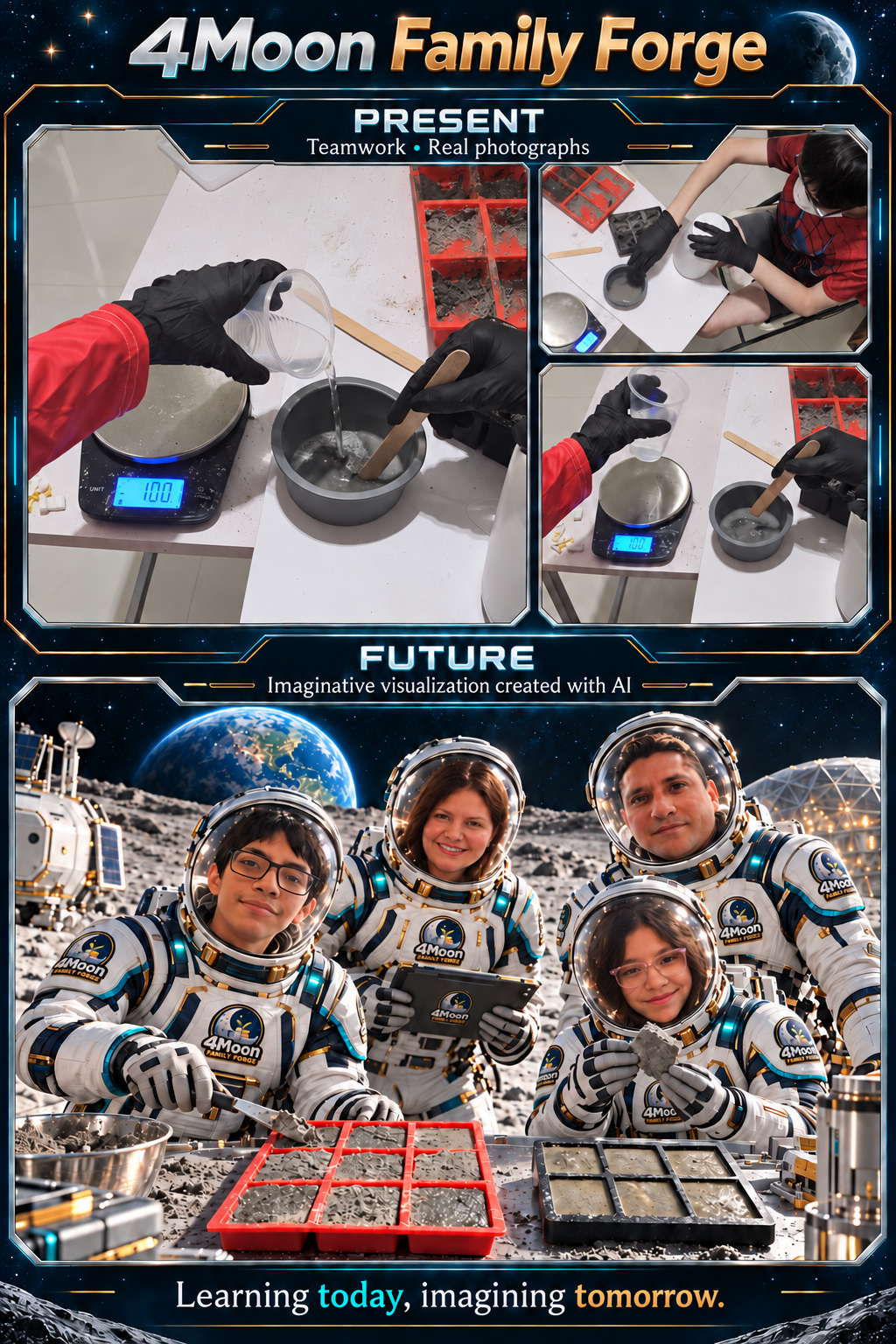
Esta oportunidad nos permite explorar la ingeniería en familia, aplicar nuestros conocimientos y aprender mediante la experimentación y el trabajo en equipo.
Actualización de mitad de proyecto
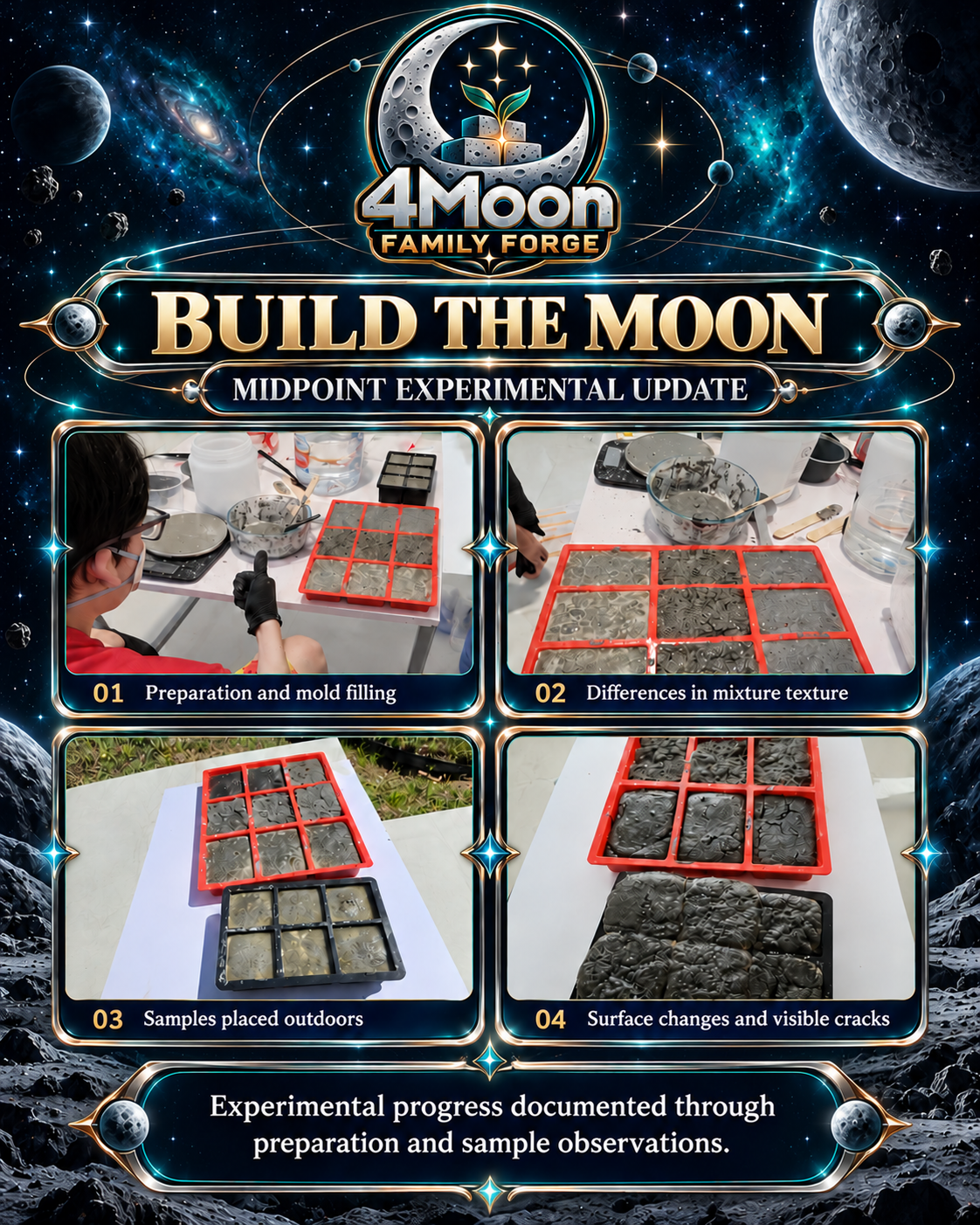
Nuestro equipo, 4Moon Family Forge, ha preparado y evaluado la mezcla de control C0 y tres mezclas experimentales: E1, E2 y E3. Tras un período de secado registrado de 32 horas, C0 soportó la mayor carga registrada, con 301.5 g, seguida de E3, con 278.2 g, y E2, con 200 g. E1 falló y desarrolló un olor fuerte, lo que impidió continuar las pruebas. Durante la prueba de agua, C0 y E3 no mostraron cambios visibles, mientras que E2 se ablandó.
Nuestros principales retos han sido lograr mezclas uniformes, reducir las grietas y controlar la cantidad de agua y de material colocado en cada molde. Las fotografías y los videos documentan diferencias en la textura, la presencia de líquido en la superficie y la forma de las muestras. Debido a que las dimensiones y las formulaciones de las muestras variaron, estos resultados son preliminares y todavía no permiten determinar cuál receta es la más resistente. Estamos aprendiendo tanto de las muestras exitosas como de las que fallaron, y utilizaremos estas observaciones para mejorar la uniformidad, perfeccionar nuestras formulaciones y orientar la próxima ronda de pruebas antes de seleccionar una receta final.
Build the Moon Challenge
Mechanical engineer Amilcar Rincon-Charris, PhD, a professor at the Inter American University of Puerto Rico, met with me and provided mentorship and guidance about pursuing a career in Mechanical Engineering. During our meeting, he introduced me to the opportunity to apply to participate in the Build the Moon Challenge.
With my family’s support, we completed the application process so that my sister and I could participate as members of 4Moon Family Forge.
We later received a notification from the Institute of Competition Sciences confirming that the Puerto Rico Space Grant Consortium had selected our team to receive sponsorship. The message stated that the sponsorship covered participation for one team of up to ten students.
This opportunity allows us to explore engineering as a family, apply our knowledge, and learn through experimentation and teamwork.
Midpoint Update
Our team, 4Moon Family Forge, has prepared and evaluated the C0 control and three experimental mixtures: E1, E2, and E3. After a recorded drying period of 32 hours, C0 supported the highest recorded load at 301.5 g, followed by E3 at 278.2 g and E2 at 200 g. E1 failed and developed a strong odor, preventing further testing. During the water test, C0 and E3 showed no visible changes, while E2 softened.
Our main challenges have been achieving consistent mixtures, reducing cracking, and controlling the amount of water and material placed in each mold. Photos and videos document differences in texture, surface liquid, and sample shape. Because sample dimensions and formulations varied, these results are preliminary and do not yet establish which recipe is strongest. We are learning from both successful and unsuccessful samples and will use these observations to improve consistency, refine our formulations, and guide the next round of testing before selecting a final recipe.